"We need a crane" is only the beginning of the conversation. A load that a truck-mounted crane sets in place in fifteen minutes can keep the wrong machine struggling for hours — or defeat it entirely. Choosing the right crane comes down to three questions: what is being lifted, where does it have to go, and does the site allow it? In this post we take all three in turn.
First, Know the Main Crane Types
Mobile (Telescopic) Crane
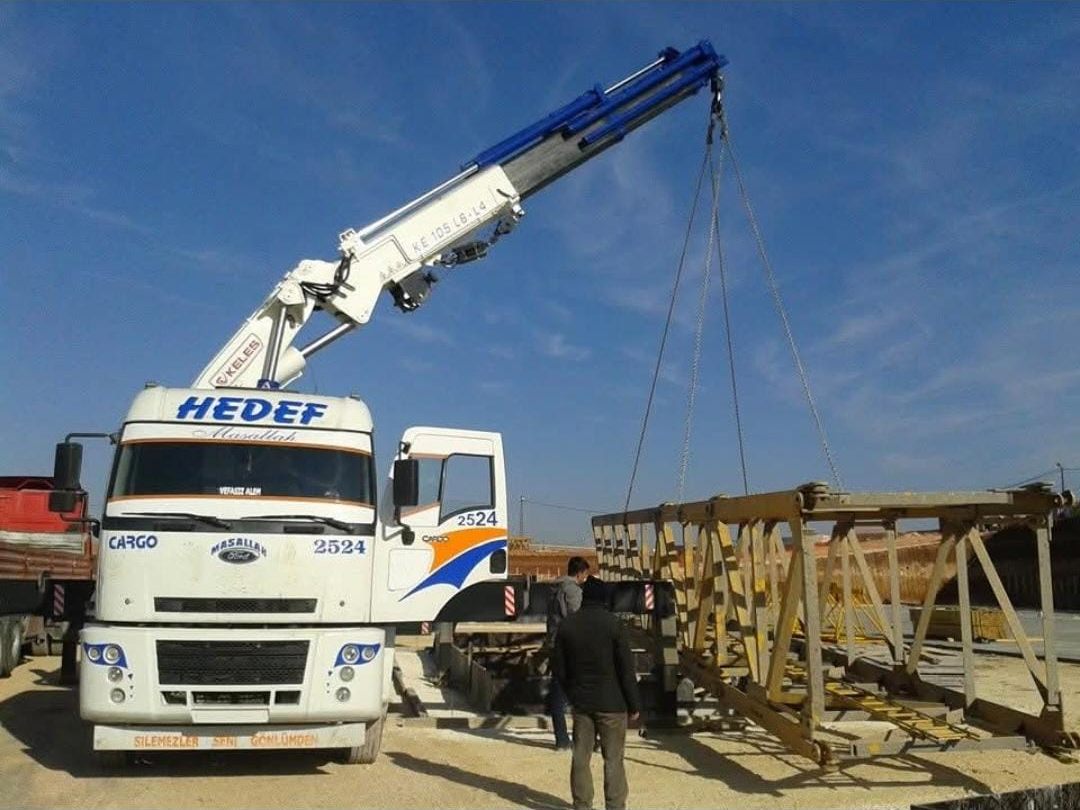
A mobile crane travels on its own chassis and lifts with a telescopic boom. It is the first choice for heavy tonnages and long reach: erecting steel structures, placing roof trusses, feeding materials to the upper floors of tall buildings, and launching or hauling out boats all belong to this class. It needs room to deploy its outriggers (stabiliser legs), but in return both its lifting capacity and its reach are far greater than the alternatives. Most of the jobs covered by our crane rental service around Bodrum and Milas fall into this category or the next one.
Truck-Mounted Loader Crane
Known locally in Türkiye as a "hiyap", this is a folding knuckle-boom crane mounted on the back of a truck. Its biggest advantage is that it can both carry the load and set it down: container deliveries, air-conditioning outdoor units, marble, glass and prefabricated elements — for mid-tonnage loads, one vehicle handles the transport and the lifting in a single trip. Because it fits into narrow streets and sets up quickly, it is the most practical option for the majority of in-town jobs.
Aerial Work Platform
An aerial platform is designed to lift people, not loads. It is used for work at height such as installing signs and billboards, facade maintenance, lighting work and tree pruning. If you need to put personnel up high rather than material, the machine you are looking for is an aerial platform, not a crane — settling that distinction at the start prevents the wrong vehicle from being sent.
Tonnage and Boom Length: Always Calculated Together
The most common mistake is to look only at the weight of the load. The capacity on a crane's badge is its maximum with the boom at its shortest and steepest; as the boom extends and flattens out, the weight it can carry drops quickly. Every crane's load chart (lifting diagram) maps exactly this relationship. To identify the right machine, three pieces of information have to be weighed together:
- Load weight: slings, chains and lifting attachments count as part of the load.
- Lifting radius: the horizontal distance between the crane's centre of rotation and the point where the load will be placed. The further the crane is from the load, the less it can lift.
- Lifting height: the floor or level the load has to reach, plus any obstacles that must be cleared along the way (parapets, roof eaves, trees and so on).
A crane that cannot get close to the building, for example, has to lift the same load with a much longer boom over a wider radius — which is how a machine that looks "big enough" on paper ends up falling short on site. That is why saying "it's a 2-tonne load" on the phone is never the whole story: where the crane can set up and where the load has to go matter at least as much as the weight itself.
Practical tip: before asking for a quote, take a few photos of the site and the load with your phone, and pace out the distance between where the crane can stand and where the load has to be placed. Two photos and one distance sent over WhatsApp are enough, for most jobs, to pin down the right machine on the very first call.
Assess the Site: Can the Machine Even Get In?
Even with the right tonnage and boom, the lift cannot go ahead if the site does not allow it. These are the main points we check during a site visit:
- Ground: the crane must set its outriggers on firm, stable ground. Soft soil, fresh fill, manhole covers and slabs above basements are risk zones; where needed, steel plates or timber mats are planned under the pads.
- Access route: the width of the road into the site, sharp turns, low bridges and gate clearances are checked in advance. In Bodrum's narrow streets this is very often the deciding factor.
- Power lines: if an energised line falls inside the boom's working envelope, a safe clearance must be kept — or an outage arranged with the utility company. This is a safety rule that is never up for negotiation.
- Working area: the space needed to spread the outriggers, the path the load will travel through the air, and the surrounding structures, vehicles and pedestrians are all considered together; temporary traffic arrangements are made where necessary.
Still Not Sure? Leave the Choice to Us
The right machine for a job is decided on site, not at a desk. That is why, whenever a job is not clear-cut, we come out for a survey first: we look at the load, the distances and the ground in person, and recommend the crane that genuinely fits the work. You neither overpay for a machine larger than you need, nor lose a day to one that cannot cope. For jobs in Milas, Bodrum and the surrounding area you can reach us 24/7 — call +90 532 294 48 63 (English spoken) or +90 533 708 92 00, describe the job briefly, and we will plan the rest together.